Monday, 6 July 2026
A Most Bloody Devotion: I made a game
A released a game! A Most Bloody Devotion, a romantic horror game about cannibalism, gender, and love. I think it's pretty neat, go check it out!
https://anxiousmimicrpgs.itch.io/most-bloody-devotion

Friday, 23 January 2026
Prophecies: Time Is A River And Baby, We're Throwing Rocks
Time is a river that flows only one direction. We are leaves carried on an eternally-flowing current until the water eats us away.
Time travel backwards is impossible. Physical things, as a hard rule, can only go in one direction. You can certainly speed up your passage. Many wizards are capable of moving forwards in time. Beings from the past have reappeared in the present, but travel backwards is impossible.
Except, of course, if something truly major happens.
When you throw a pebble into the water, it creates a ripple. That ripple is itself swept along by the current, the motion extending infinitely into the future and influencing the flow of everything that comes after it. Butterflies and hurricanes. This is causality.
But, right at the moment of impact, for a very short period of time, the ripple extends upriver. A leaf may, perhaps, flow over it and for just a brief second, touch the future.
Prophetic Rules
The degree to which a ripple extends backwards is always a fraction of how far it extends forwards. The death of a hermit alone in the woods may only be noticeable in the seconds before his death. If you can tell the future in a fight, you might be able to see your own death a couple seconds ahead, but little else. Even the greatest of kings may learn of their death no more than a few weeks in advance.Hard knowledge is impossible. A ripple is affected by the motion of the river it spreads backwards into. It will become distorted and unclear with time. Telling the future a second beforehand is near-crystal-clear. Look a week earlier and things may be distorted and blurry.
Paradoxes are possible. Free will does exist, ever since Rumen broke the back of fate and locked him in a coffin above the Door to Deepest Dark. Larger stones are harder to shift when you cannot touch them, but a small pebble may be slipped around entirely simply by knowledge of its coming.
Mechanics
Fortunes are measured in Chronological Distance and Abstraction. Chronological Distance causes abstraction.- No Abstraction. Charles sees Mark in bed with Edith, sees himself walking in on it, and sees Mark kill him
- Minor Abstraction. Charles sees Mark in bed with Edith, but not the murder/Charles sees himself being killed by his wife’s lover, but does not know that it’s his best friend
- Moderate Abstraction. A knight is stabbed in the back
- Major Abstraction. A man walks in the forest. He picks a flower and takes it with him. A serpent bites his foot, poisoning him, causing him to drop the flower.
Telling the Future
When you look into the future, choose a fortune-telling method or make one.- Palm reading: Moderate abstraction for any chronological distance if done to a babe at the moment of their birth. Otherwise unreadable abstraction.
- Tarot cards. Moderate and minor abstraction is told through a consistent set of metaphors, allowing common events (deaths, births, betrayals) to be easily taught
- Astronomy. Always major abstraction, regardless of chronological distance.
- Haruspicy. Lowers abstraction by 1 category but requires an animal sacrifice.
- Bone-Casting. Maximum abstraction is moderate when predicting deaths
- Warrior’s-Divination. Never goes beyond a few seconds of chronological distance, but can be practiced while fighting.
Prophecy Beasts
If there’s a river, some things cannot be moved. They’re so set in the riverbed that a leaf caught on them will be stuck, unable to move forwards.Prophecy Beasts do not move backwards or forwards in time, existing in their own instant-infinity. Encountering one will trap you with them until they are dislodged. They exist in a sole instant of time, alone for eternity, unless you touch upon them in the perfect place at the perfect moment.
Prophecy Beasts can be locations, objects, creatures, or concepts. They are above death and must be given a fate to re-enter time where they became stuck in it. This can be done by giving them a new soul, trading them your fate, or successfully changing their form into being unstuck.
Friday, 16 January 2026
Marks: What if Saves, Stats, and Hp were all the same thing?
Combining saves and stats is obviously not new, but I feel like we could take it a bit further. Do we really need HP?
Stats
How stats exactly work doesn’t actually matter a ton, so long as we’ve got the philosophy that each stat represents a different way to avoid danger. I’ve got:
- Tough
- Fast
- Sneaky
And then different classes can give you others. For example:
- A Fighter can get Well Trained
- A Paladin can get Divine Luck
- A Wizard can get Protective Wards
Etc. You can even have stats you get diegetically, maybe you meet a master in the woods and she teaches you the Skin Of Stone stat or the Reading the Wind stat.
Rolling
When you are in danger, you pick and roll a stat to avoid it with. Obviously some things just won’t work: if you’re in the middle of a group of guards, sneaky probably isn’t going to cut it, try something else.
Rather than success/failure, we have Success + Marked Success.
- On a Success, you avoid the danger
- On a Marked Success, you avoid the worst of the danger, but get a Mark
Marks
A Mark is an injury, curse, or effect placed over one of your stats. While a stat is marked, you can’t use it to avoid danger.
The default Marks might be like, “Injured [body part],” “Spooked,” “Hungry,” but different monsters might have specifics, like a dragon might have “Charred to a Crisp” or a Nymph might have “Entranced” or “Wrapped up by vines.”
Marks stick around until they logically would be removed in-fiction.
If all your stats are marked, you can’t roll to avoid it if you’re in danger: probably, this means death, but it basically just comes down to “if a monster wants to do something to you, sorry bud, it happens.”
Why do I like this system?
- Diegetic ties between your ability, your injuries, and when you get hurt.
- Forces characters to use their less-favoured stats sometimes.
- Reduces numerical bookkeeping.
- Your death is unlikely to come as a surprise; it’s a lot harder to die before you have 0-1 stats remaining. It’s still lethal, but it’s a bit more about being ground down by the dungeon rather than getting unlucky.
- More stats = higher ‘HP.’ Higher stats = less chance of getting a Mark in the first place. There’s flexibility in how to use it.
Here's a proof of concept for a system that uses this engine, including a core dice mechanic, GLOGian magic system, example class, and example monster
Friday, 8 August 2025
Cloak and Sword: The Magicien
Class: The Magicien
Start with a knife, 2d4 random Ritual Components (roll D12s), and a dark cloak.
Black Book. You have a book bound in ink-stained flesh (traditionally human, practically often pig-leather). It contains your soul, and if it is ever destroyed so are you. It is also necessary for your Workings and holds Devil-Names.
Devil-Names. Your Black Book contains the names of devils. The only one it currently has is the name Pasau (see Summoning a Serpent). When you find new names, the GM will grant you new Workings allowing you to summon them. Any devil in your Black Book holds Esprit for you.
Outlaw. You are a wanted criminal. Every week you stay in a town has a 1-in-6 of bringing the law down on your head. You are invisible to God.
Devil-Sworn. You have -1 reaction rolls from peasants and -2 reaction rolls from angels and princesses, but +2 reaction rolls from Devils. You hold Esprit for faeries (this means they may make an Esprit reaction roll against you, the results of which you must obey).
Witchflesh. You cannot feel pain unless pierced with silver needles. You can be harmed and dismembered to the point of incapacity, but may only be permanently killed by fire or by the hand of an ordained priest.
Ritual Components. You can gather/make 1 Ritual Component/day with 1d4 hours of effort. While in town or city, roll a D12. In a village, roll a D8. In the wilderness, roll a D4. In a dungeon, roll 1d6+6. Components take up 1/4th of an inventory slot each.
Feathers
Bloodsoaked braid
Jawbone shavings
Blackmarrow root
Consecrated salt
Kidney stones
Spiced chalk
Half-silvers
A pickled organ
Faerie flowers
Murder talisman
Human teeth
Workings.
You can cast any of the following Workings, so long as you have the components for them and your Black Book. Casting a Working takes 1 minute and uses up the components. You cannot cast Workings within a church, and all Workings take 10 minutes during holy days or the Lord’s Day.
A Protective Circle. Feathers, bloodsoaked braid, jawbone shavings. Draw a circle on the ground, up to ten paces across. Spirits, devils, the possessed, and other similar beings may not cross the circle until a mortal disturbs it.
Calling of the Unhallowed. Pickled organ, murder talisman, human teeth. All corpses you could see if you spun in a circle (which you must do) spring to life until dawn. They desire the flesh of the living. You may designate up to 3 people as safe from them, +1 per additional component expended.
The Facetaking Rite. Kidney stones, murder talisman, faerie flowers. As part of this working, kill a human and bathe a participant in their blood. The participant takes on the victim’s form in all respects, and may mimic them perfectly. This is permanent.
False Rest. Jawbone shavings, half-silvers, picked organ. At any time, you or someone else you cast this spell on may pretend to be dead. This is perfectly convincing, and you may stay in this state for up to 3 days before reality catches up with you.
Summoning a Serpent. Bloodsoaked braid, consecrated salt, spiced chalk. You produce a venomous serpent (secretly a devil named Pasau) from the mud. It has all the capabilities of a regular serpent (biting, slithering, lying, etc).
Transforming of Self. Feathers, blackmarrow root, kidney stones. Take on the form of a raven, cat, or toad. Lasts until dawn.
Transforming of Things. Spiced chalk, half-silvers, human teeth. Swallow an object or small creature (you must be able to swallow it whole without damaging it). You then spit out any other object or small creature that can fit up your throat. Doing this with metals other than iron has a 1-in-6 of making you deathly ill from metal poisoning, and gems cannot be produced or transformed at all.
The Vanishing. Blackmarrow root, consecrated salt, faerie flowers. One object or living thing becomes invisible until submerged completely in water. Each hour a living thing is in this state, they become undetectable to another sense (1d3: 1=touch, 2=hearing, 3=memory). If someone is wholly undetectable, they stop existing
Tuesday, 10 June 2025
Giving Names to Devils.
The sages say no devil from The Realm Beneath is born with a name. A name is an imposition of language and will, but it is also a gift that grants the same. Giving a name to a child is the end of the forging process that creates a person.
(Note: some cultures do not give their children names, leaving them as unruly and animalistic. The process of choosing a name for oneself requires an extreme act of cunning and will, and therefore nameless children are the most likely to become wizards. It is said that the Prince of Skies chose all of his names so that none would hold any power over him).
Devils are not born with names, but unlike all others they have nobody to give them one, and no culture to infer their own names from. Even the lowest of beasts have siblings, parents, kin - even a raven name or bear name is still better than none at all.

Artist unknown, please let me know if you know the source
(Note: wolves steal the names of those they eat, but they are a rare exception)
Therefore, each devil is weak and helpless when born in hell, and will remain such for eternity.
Unless it is summoned.
To call something requires a name. This is an immutable rule. Dogs may be called because we give them names, but cats are given secret names by their mothers and so must accept the ones we give them before they work. Demons are no different. To summon a demon to do one’s bidding, that demon must have a name crafted and forced upon it.

insaneisane.deviantart.com, although account appears to be deactivated, I believe they are now insaneisane on Instagram
Were one to summon a demon and give it the name of a person, such as Mary, or Goose, or Puram, and summon it for no other reason than to grant it a name, then that demon would be a person. But no wizard would do that. The cost of summoning is too great, and demons are too strong when named with dangerous names, and so they are given Cage-Names. Names of life-enders and perfect companions and fountains of knowledge. They match themselves to their names and enact their roles with ruthless and creative efficiency.
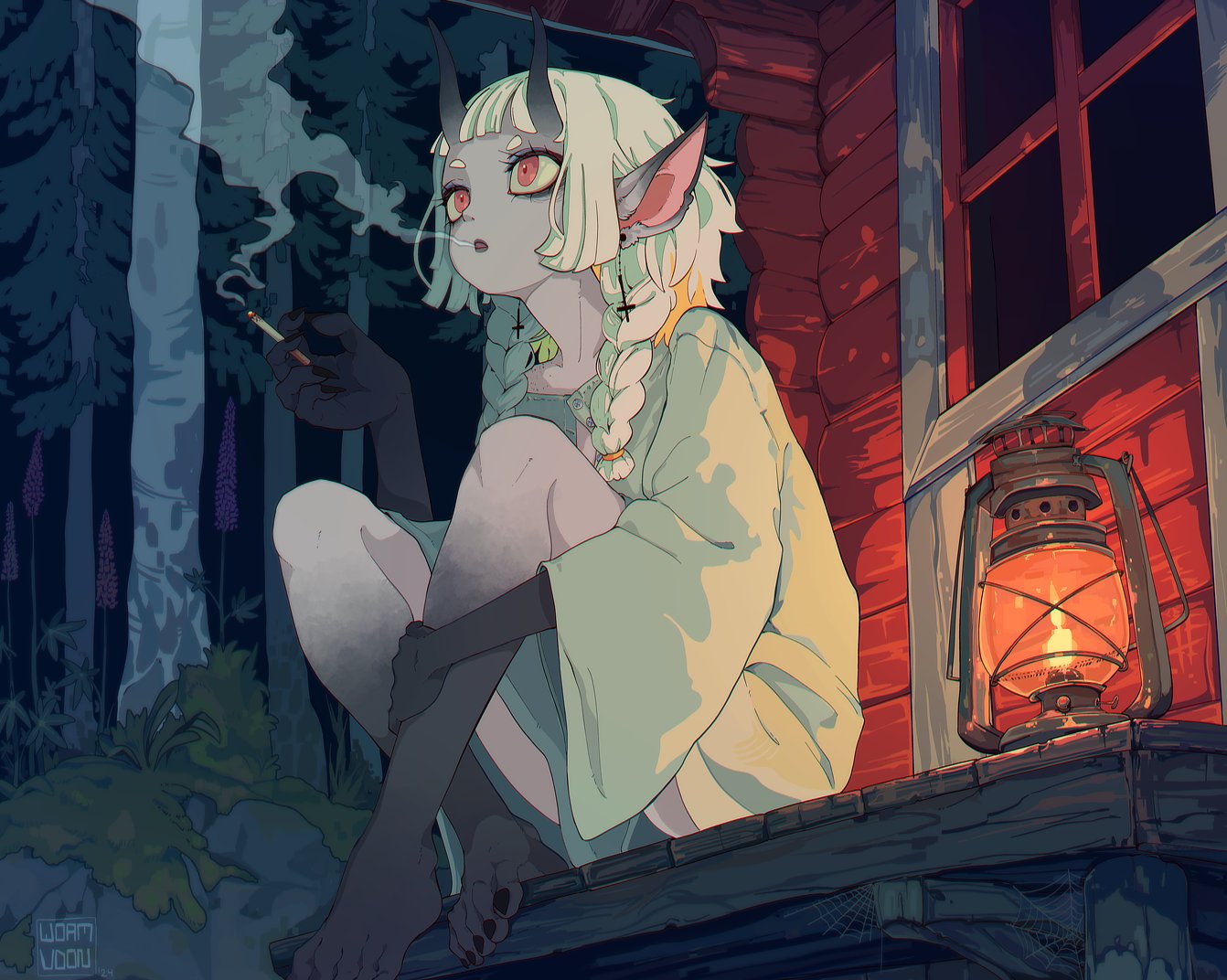
This is what a person-demon would look like. Source is @wormudon on twitter
Before the Last Days, it was thought that demons were the evilest beings in existence. Scholars now understand that the wizards who summoned them were far, far worse, for no demon would have ever left the Realms Below were it not for the wizards who gave them their names.
(I'll probably do a demon-namer class soon, if so will link it)
Friday, 6 June 2025
Questing Knight (GLOG class) +D6 swords, titles, and disgraces
Questing Knight
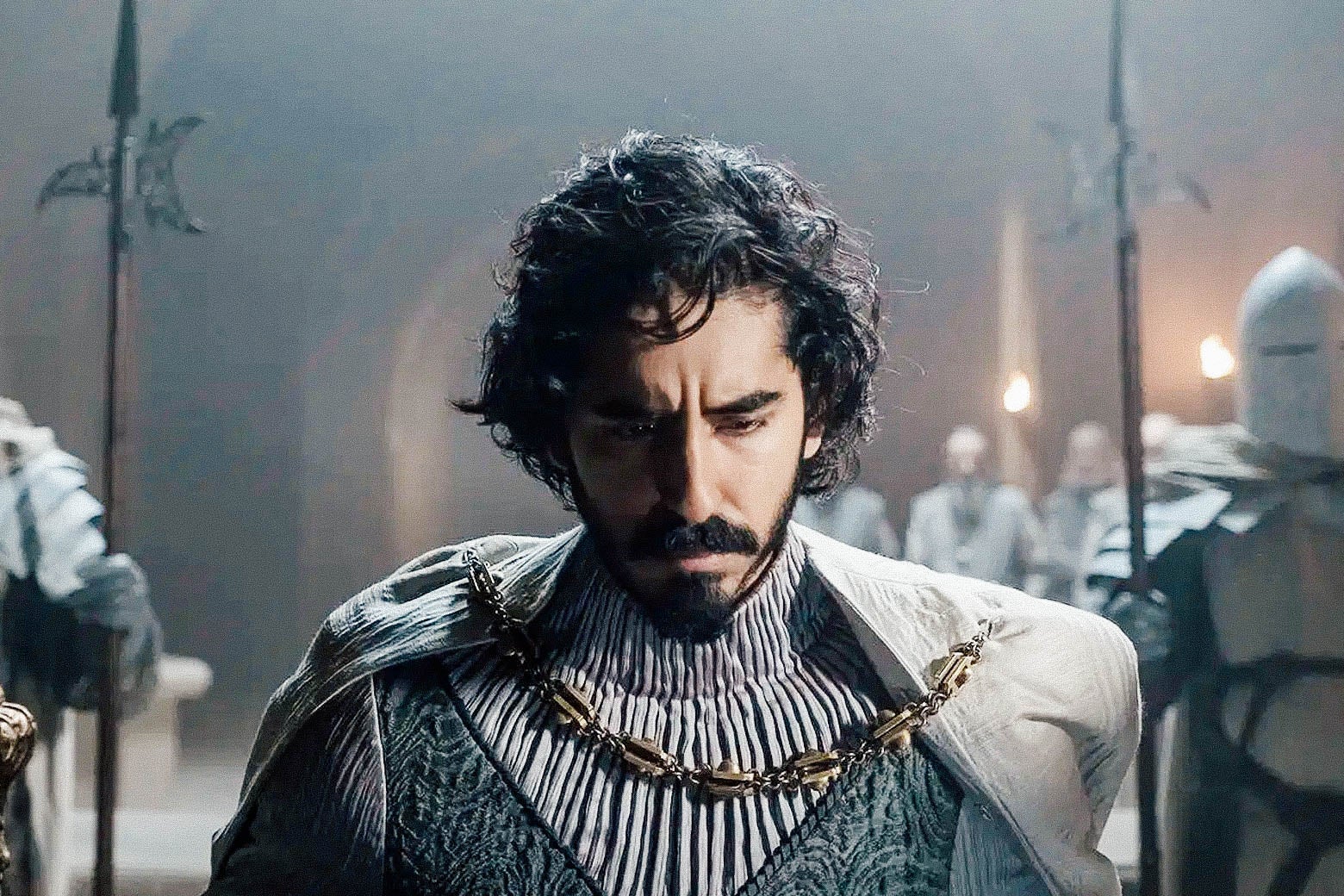
The Green Knight - channel this dude's wet cat energy
Equipment: A sword, shield, chainmail, sad warhorse
Class Trait: You get +2 HP and -1 save vs Charm for each Questing Knight template you have.
Skills: Horsemanship, Farming, or Politic
Quest
You may at any point declare a Quest - you may have 1 Quest at a time, and if you leave your Quest you gain 2d4 Fatigue.
There are 3 kinds of quests. You do not get a reward for a Quest unless you have declared it, but you can add +[templates] to any rolls to complete it.
You may begin the game with 1 random Title, Sword, or Disgrace (1d6: 1-2=Title, 3-4=Sword, 5-6=Disgrace)
Chivalric Behavior
Your code of chivalry must include the following, but can have more:
Always protect those in need
Always treat others with courtesy and without judgement
Never decline a duel or challenge
Never decline a gift or break a promise
So long as you live by your code unwaveringly, supernatural beings, peasants, and young nobles will act the same.
If you ever break your code, you become cursed.
A Genuine Pleasure
If you are polite, friendly, and honest, local lords, wizards, ogres, and witches will allow you into their homes and keep you as a welcome guest, giving you and your party food, drink, and a place to safely rest.
Fair Maiden
You hear tell of a Princess being held captive by a Dragon. Ask the GM where she is.
Gentle and Strong
When a bully or monster attempts to attack someone near you for the first time each day, you can step in and block the attack with your shield.
Great Oath
Once, when you declare a quest, it will be accomplished, so long as you keep trying. The GM may break every other rule to ensure it.
D6 Titles
Titles give social benefits or personal boons.
D6 Swords
Swords give magical swords (or other equipment).
D6 Disgraces
Disgraces give magical powers and dark magics.
Subscribe to:
Posts (Atom)